What Is Wholesale Real Estate?
Wholesale real estate is the business of finding a property priced well below its potential value, signing a purchase contract with the owner, and selling the rights to that contract to another buyer — usually a house flipper or a landlord paying cash. The wholesaler is not selling the house. The wholesaler is selling a position in a contract: the right to buy a specific property at a specific price.
That distinction matters. Because the wholesaler never closes on the property, there is no loan to qualify for, no down payment, and no renovation budget. The main out-of-pocket costs are the earnest money deposit and the marketing needed to find sellers. The value a wholesaler provides lives in the deal itself: locating a motivated seller before anyone else does, negotiating terms that leave room for profit, and delivering that opportunity to an investor who is ready to close.

Every party gets something. The seller trades top dollar for speed and certainty — an as-is sale with no showings and no listing commissions. The buyer receives a pre-negotiated deal without spending months hunting for it. The wholesaler earns a fee for making the match.
How to Wholesale Real Estate: The Deal in Five Steps
Every wholesale deal follows the same basic sequence. Mastering each step — especially the numbers — is what separates wholesalers who close deals from those who simply sign contracts.
1. Find a Motivated Seller
The best wholesale deals come from owners who value speed and convenience over price: heirs with an inherited home, owners of vacant properties, tired landlords, owners behind on payments, or anyone holding a house that needs more repair than they can afford. Common ways to find them include “driving for dollars” (spotting vacant or neglected homes and looking up the owner in county records), direct mail and targeted online ads, probate and pre-foreclosure lists, for-sale-by-owner listings that have gone stale, and referrals from agents and other investors.
Leads fall into two buckets. Outbound leads come from the wholesaler making first contact through calls, door knocking, and mail. Inbound leads come from marketing that brings sellers to the wholesaler. Rich Dad contributor Brent Daniels breaks down both approaches in How Successful Wholesalers Become Rich.
2. Run the Numbers Backward From the Buyer
A wholesale price has to work for the end buyer first. Many cash buyers use a version of the 70% rule: they will pay no more than 70% of a property’s after-repair value (ARV), minus the cost of repairs. That figure is the buyer’s maximum allowable offer, or MAO. Subtract the wholesaler’s target fee, and what remains is the most the wholesaler can offer the seller.
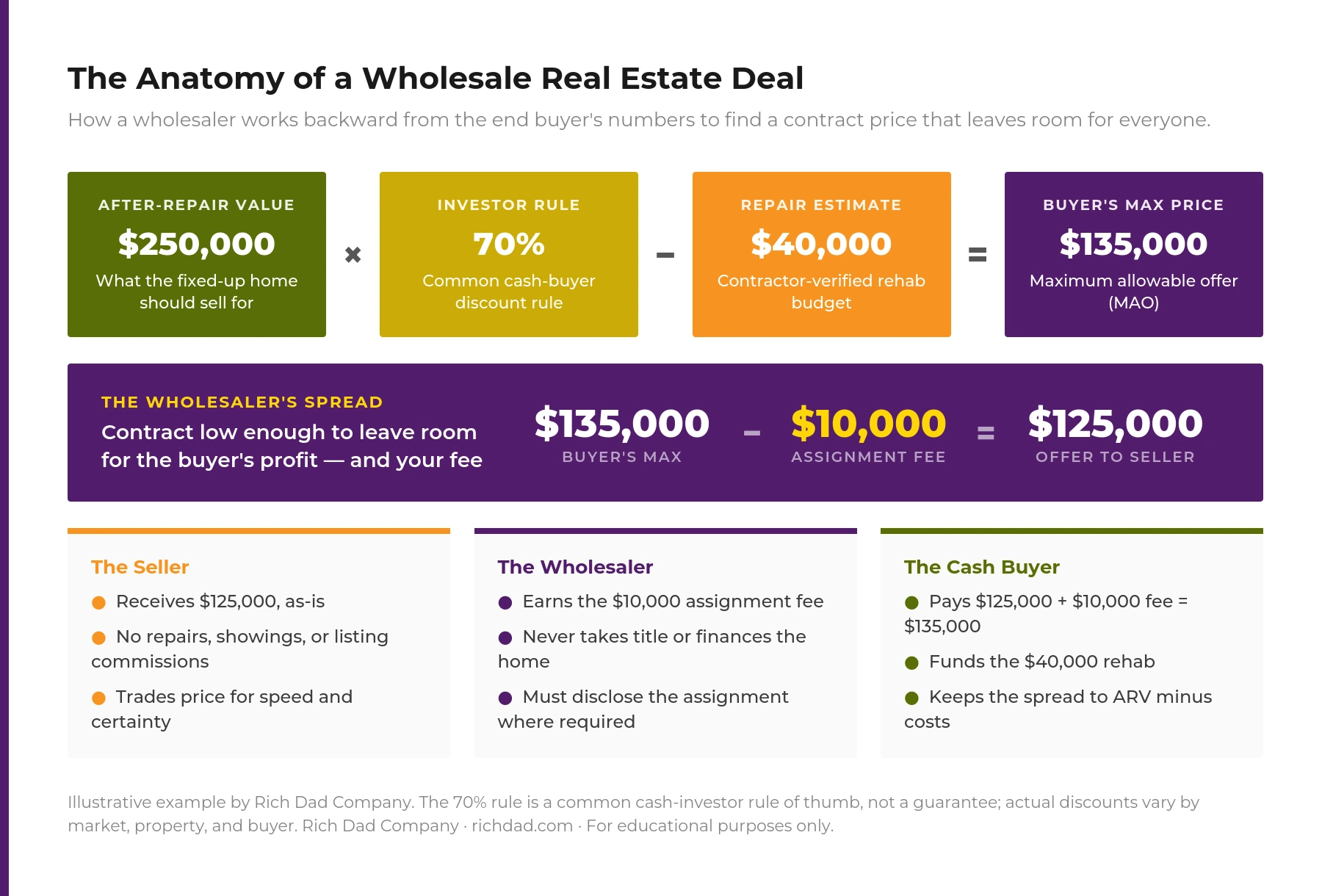
In the example above, a home worth $250,000 once repaired and needing $40,000 of work supports a buyer price of about $135,000. To earn a $10,000 fee, the wholesaler needs a contract at $125,000 or less. The two numbers that make or break the deal are ARV and repair costs — which is why experienced wholesalers pull recent comparable sales, walk the property with a contractor when possible, and pad their repair estimates rather than trim them. An overpromised deal can’t be assigned, and a wholesaler who burns buyers with bad numbers rarely gets a second chance.
3. Sign an Assignable Contract — With Protection
The purchase agreement must allow assignment, often by naming the buyer as “[Your Name or Company] and/or assigns,” and it should give the wholesaler both time and a legitimate exit. Standard protections include an inspection or due-diligence period, a closing date far enough out to find a buyer, and an earnest money deposit sized to the risk. Keep contingencies few and honest. A contract riddled with escape clauses erodes a seller’s trust — and in a growing number of states, failing to disclose the intent to assign gives the seller the right to cancel.

This is where a real estate attorney earns their fee. Contract language that is routine in one state can be noncompliant in the next.
4. Market the Contract to Cash Buyers
An old wholesaling maxim holds that the money is in the list. The fastest way to sell a contract is to have buyers lined up before signing it. Build a buyers list through local real estate investor associations, “we buy houses” operators, landlords, contractors, and recent cash purchasers found in public records. Call each buyer to learn exactly what they want — neighborhoods, property types, price ranges, and minimum profit — then send each deal only to the buyers it fits.
Advertise honestly. Many states restrict publicly marketing a property a wholesaler does not own unless the marketing makes clear that what is being sold is an interest in a contract, not the home itself.
5. Close Through an Investor-Friendly Title Company or Attorney
Once a buyer signs the assignment agreement and posts a deposit, closing proceeds much like any other sale. The end buyer closes with the seller, and the assignment fee is paid to the wholesaler on the settlement statement. A title company or closing attorney experienced with assignments keeps the process smooth and transparent for every party at the table.
Assignment vs. Double Closing
There are two main ways to get paid on a wholesale deal. In an assignment of contract, the wholesaler transfers the purchase agreement to the end buyer and collects a fee, which appears on the closing documents. In a double closing, the wholesaler actually buys the property and resells it to the end buyer in back-to-back transactions, often on the same day and frequently using short-term transactional funding.
A double close keeps the spread less visible and works when a contract can’t be assigned — many bank-owned sales, for example, prohibit assignment. The tradeoff is a second set of closing costs and more risk, because the wholesaler briefly takes title. How each structure is treated under licensing and disclosure rules varies by state, so the choice belongs in the conversation with a local attorney.
Wholesale Real Estate vs. Fix-and-Flip
Wholesaling is often confused with flipping houses, but they are different business models with different risks.
Wholesaling vs. Fix-and-Flip
Two different business models with different capital needs, timelines, and risks.
| Factor | Wholesaling | Fix-and-Flip |
|---|---|---|
| Ownership | Never takes title (in an assignment) | Buys and owns the property |
| Upfront capital | Earnest money plus marketing | Purchase price or down payment plus rehab budget |
| Financing | None required | Cash, hard money, or a loan |
| Timeline | Typically days to weeks | Typically several months |
| Profit source | Assignment fee | Resale spread minus rehab, holding, and selling costs |
| Main risks | Lost earnest money, damaged reputation, legal noncompliance | Rehab overruns, market shifts, carrying costs |
| Skills built | Deal finding, valuation, negotiation, marketing | All of those, plus project management and financing |
Wholesaling carries less capital risk and a smaller profit per deal. Flipping carries more of both. What they share is the foundation every real estate investor needs: the ability to find and price a deal that others miss.
How Much Money Can You Make Wholesaling Real Estate?
Assignment fees typically fall between $5,000 and $20,000, with larger fees possible on higher-priced properties or deeper discounts. There is no ceiling in theory. In practice, there is one — and it is set by the end buyer’s margin.
That margin is under pressure. According to ATTOM’s 2025 year-end U.S. Home Flipping Report, the typical flipped home produced a gross profit of $65,981 in 2025, a 25.5% return on the purchase price and the lowest since 2008 — and that figure is calculated before rehab, holding, and selling costs.
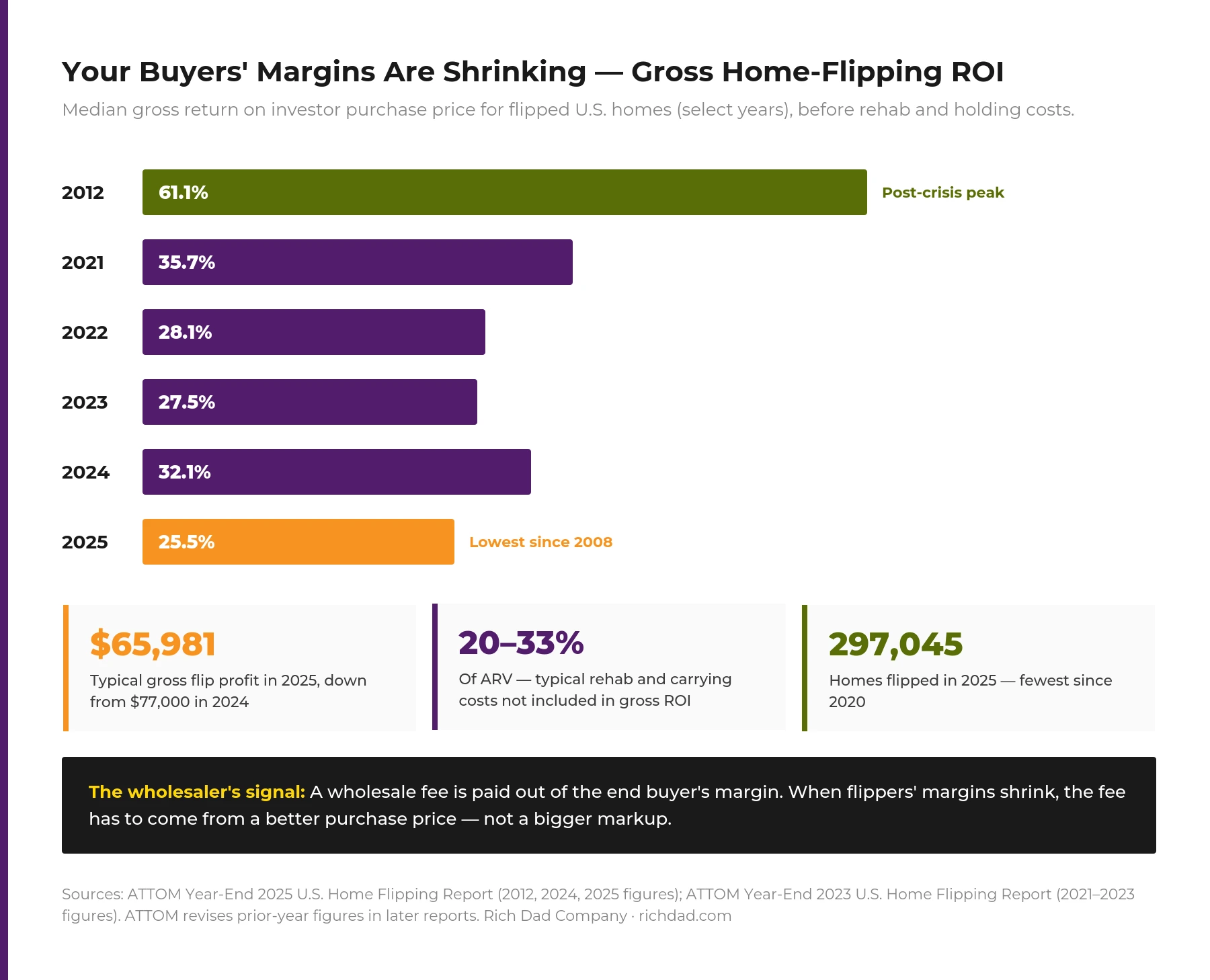
When flippers make less, they pay less, and they scrutinize every wholesale deal harder. The lesson for a wholesaler is straightforward: the fee has to come from a better purchase price, not a bigger markup. In a tight market, the wholesalers who thrive are the ones who find genuinely distressed, off-market sellers — not the ones who add $20,000 to a retail-priced listing and hope a buyer doesn’t notice.
Income also depends on volume and consistency. The first months can produce no closed deals while a pipeline is built, and marketing costs arrive before the first check does. Treat wholesaling like the business it is: set a lead-generation budget, track cost per lead and cost per closed deal, and expect a learning curve.
Is Wholesaling Real Estate Legal? What Changed in 2025 and 2026
Wholesaling remains legal in most of the country, but the old answer — “you don’t need a license” — is increasingly incomplete. Lawmakers have responded to high-pressure “we buy houses” tactics with disclosure mandates, seller cancellation rights, registration requirements, and licensing thresholds.
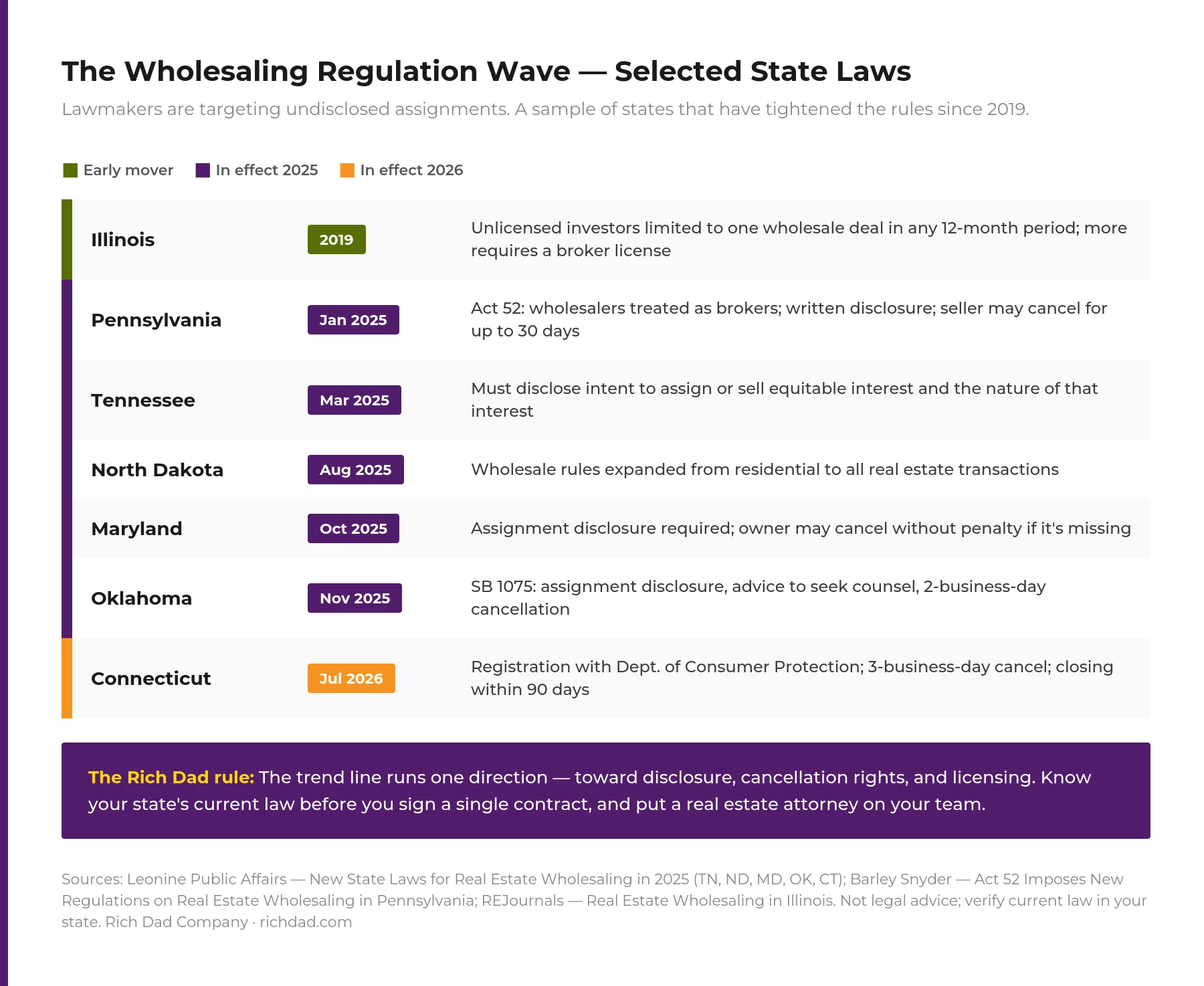
Illinois was an early mover. Under the state’s amended Real Estate License Act, anyone who wholesales on two or more occasions in a 12-month period is treated as engaging in a pattern of business that requires a broker license. Pennsylvania went further with Act 52 of 2024, which folds wholesalers into the definition of “broker,” requires prominent written disclosure that the contract is a wholesale transaction, and lets the seller cancel until the earlier of 30 days after signing or conveyance.
The pace accelerated in 2025, when six new wholesaling laws were enacted across Connecticut, Maryland, North Dakota, Oklahoma, and Tennessee. The common thread is disclosure: sellers must be told, in writing, that the buyer intends to assign or sell their interest. Oklahoma added a two-business-day cancellation window, Maryland lets owners cancel without penalty if the disclosure is missing, and Connecticut’s law — effective July 1, 2026 — requires registration with the state’s Department of Consumer Protection, a three-business-day cancellation period, and a closing date no more than 90 days out.
The practical rules follow directly. Disclose the intent to assign in writing, every time. Check the current law in each state before marketing a single deal. Consider getting licensed if volume is the goal; a license can add credibility and market access, though it also brings duties to disclose licensee status. And put a real estate attorney on the team before the first contract, not after the first complaint. Rich Dad’s legal and asset protection resources cover how the right advisors and structures protect an investor as a business grows. None of this is legal advice — state laws change quickly, and a local attorney is the final word.
The Rich Dad Reality Check: Wholesaling Is Earned Income
Here is what most wholesaling guides leave out. In the CASHFLOW Quadrant, Robert Kiyosaki divides the world of money into four positions: E for employee, S for self-employed, B for business owner, and I for investor. A wholesaler who personally finds, negotiates, and markets every deal sits squarely in the S quadrant. The fees are real, but they stop the moment the work stops.
The tax code agrees. Wholesale fees are generally treated as ordinary business income, not capital gains, and wholesalers operating as sole proprietors or single-member LLCs also owe self-employment tax on their net profits. Under IRS rules, self-employment tax generally applies once net earnings reach $400. There is no depreciation, no long-term capital gains rate, and no passive income treatment on an assignment fee.
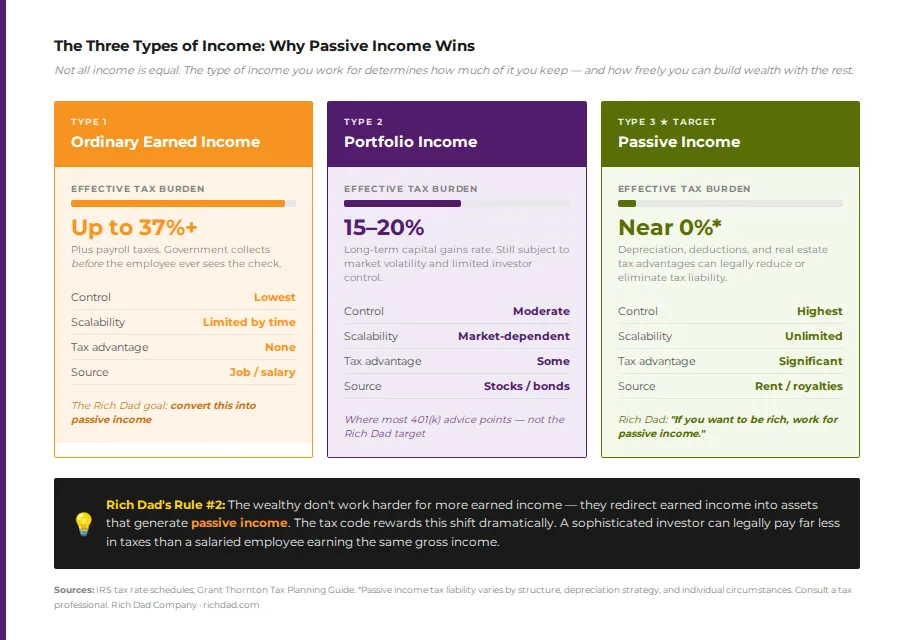
None of that makes wholesaling a bad idea. It makes wholesaling a business you own rather than an asset you hold — and an exceptional education in how deals are found and priced. With volume, entity structure and tax planning matter a great deal; Rich Dad’s business tax education is a starting point for that conversation with a qualified CPA.
From Wholesaler to Investor: Turning Fees Into Cash Flow
The highest use of wholesaling is converting earned income into assets. Every skill a wholesaler builds — finding off-market deals, estimating ARV and repairs, negotiating with motivated sellers, and assembling a network of contractors, title officers, and buyers — is exactly what a buy-and-hold investor needs.
A simple progression looks like this. First, set aside a fixed share of every assignment fee as an investment fund rather than lifestyle money. Second, start keeping the best deals instead of assigning them all. Third, use a capital-recycling strategy such as BRRRR — buy, rehab, rent, refinance, repeat — to pull capital back out of each property and redeploy it. Rich Dad’s guide to infinite returns in real estate walks through that math in detail.
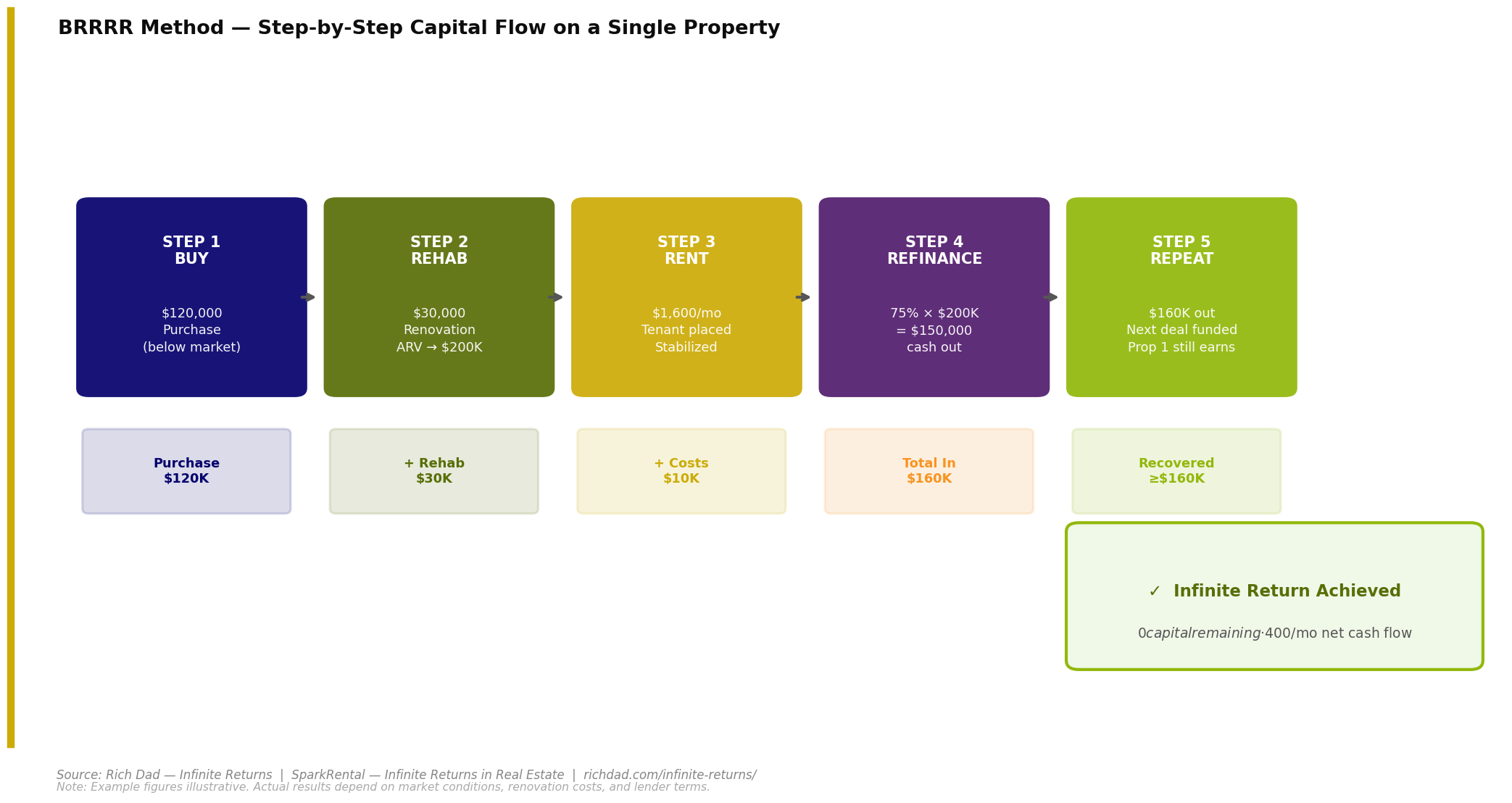
The difference is the difference between a paycheck and cash flow. A $10,000 assignment fee pays once. That same $10,000 put toward a rental that nets a few hundred dollars a month keeps paying, compounding with every property added. Before buying, run each deal through Rich Dad’s real estate cash flow evaluator, and explore other real estate investment strategies and the broader real estate investing hub to see where each fits.
Common Wholesale Real Estate Mistakes to Avoid
Most wholesaling failures trace back to a handful of avoidable errors: overestimating after-repair value, underestimating repairs, signing contracts before building a buyers list, hiding the assignment from the seller, stuffing contracts with escape clauses, ignoring state licensing and disclosure rules, and spending fees instead of investing them. Each one is an education gap — and each one is cheaper to close before the first contract than after it.
The Bottom Line on Wholesale Real Estate
Wholesale real estate remains one of the most accessible entry points into real estate investing. It requires little capital, no financing, and no tenants, and it builds the deal-finding and negotiating skills that every serious investor needs. But it is also more regulated than ever, more competitive as flippers’ margins shrink, and taxed like the active business it is.
Rich Dad’s view is simple: treat wholesaling as a financial education with a paycheck attached. Learn the numbers, respect the law, protect the seller, and route the fees into assets that produce cash flow. For a risk-free way to practice seeing deals the way investors do, play CASHFLOW — the game Robert and Kim Kiyosaki created to teach exactly that.
FAQs
It depends on the state. Many states still allow unlicensed wholesaling of a contract the investor holds, but Illinois requires a broker license after one deal in a 12-month period, Pennsylvania now treats wholesalers as brokers, and several other states require written disclosure, registration, or seller cancellation rights. Check current state law and consult a local real estate attorney before signing any contract.
Less than almost any other real estate strategy. The main costs are the earnest money deposit, which is negotiable, and marketing to find motivated sellers. Budget for legal review of contracts and for several months of marketing before the first deal closes.
Assignment fees commonly range from about $5,000 to $20,000 per deal, depending on the property, the discount, and the local market. The fee is limited by how much profit remains for the end buyer after repairs and holding costs.
A wholesaler sells the right to buy a property and never renovates it. A flipper buys the property, renovates it, and resells it. Wholesaling requires less capital and carries less risk per deal, while flipping offers larger potential profits in exchange for more capital, time, and risk.
Wholesale fees are generally taxed as ordinary business income and are subject to self-employment tax, rather than the lower long-term capital gains rates available to many investors who hold property. A CPA experienced with real estate can advise on entity structure and deductions.
It can be, because it teaches deal analysis, negotiation, and marketing with little capital at risk. Beginners succeed when they learn the numbers first, build a buyers list early, follow state law, and use their fees to acquire cash-flowing assets rather than treating wholesaling as a permanent job.